Red light therapy for sleep has some small, encouraging studies behind it, and not much more. A 2026 meta-analysis found a modest improvement in sleep quality scores, then warned that the evidence is limited. So it's worth trying if you're curious. It is not a fix for insomnia.
There's also a mix-up worth clearing up first. People use "red light for sleep" to mean two different things.
Two Different Things Called Red Light for Sleep
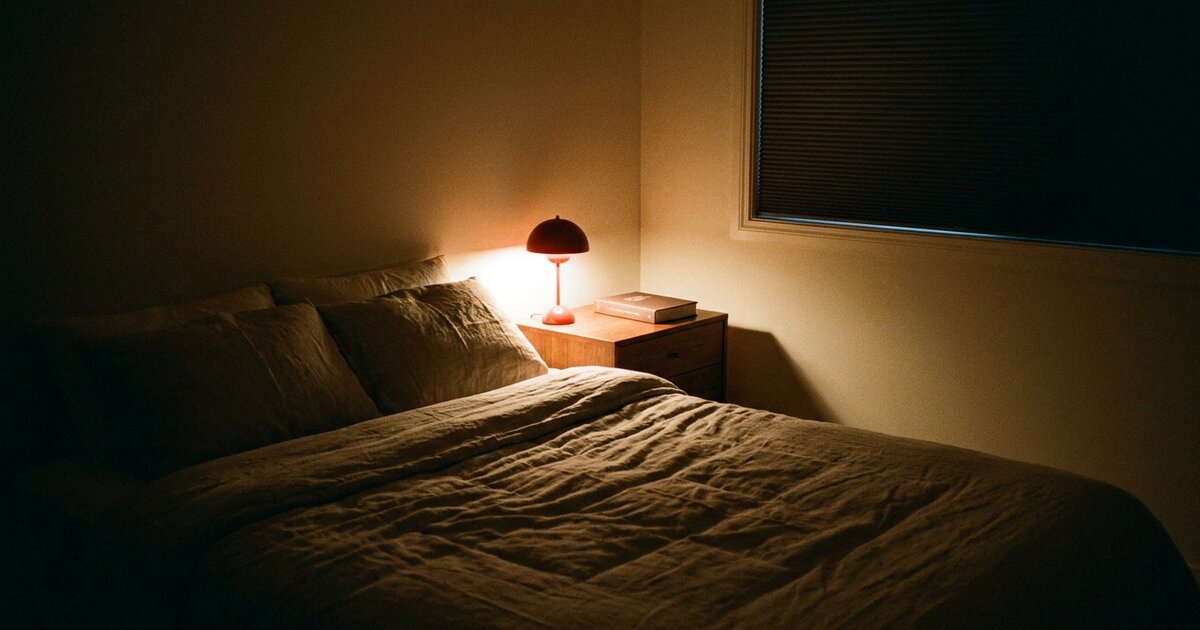
Dim red light at night. A low red or amber bulb in the bedroom or bathroom so you can see without waking your brain up. This is about avoiding blue light, and it's backed by solid circadian science.
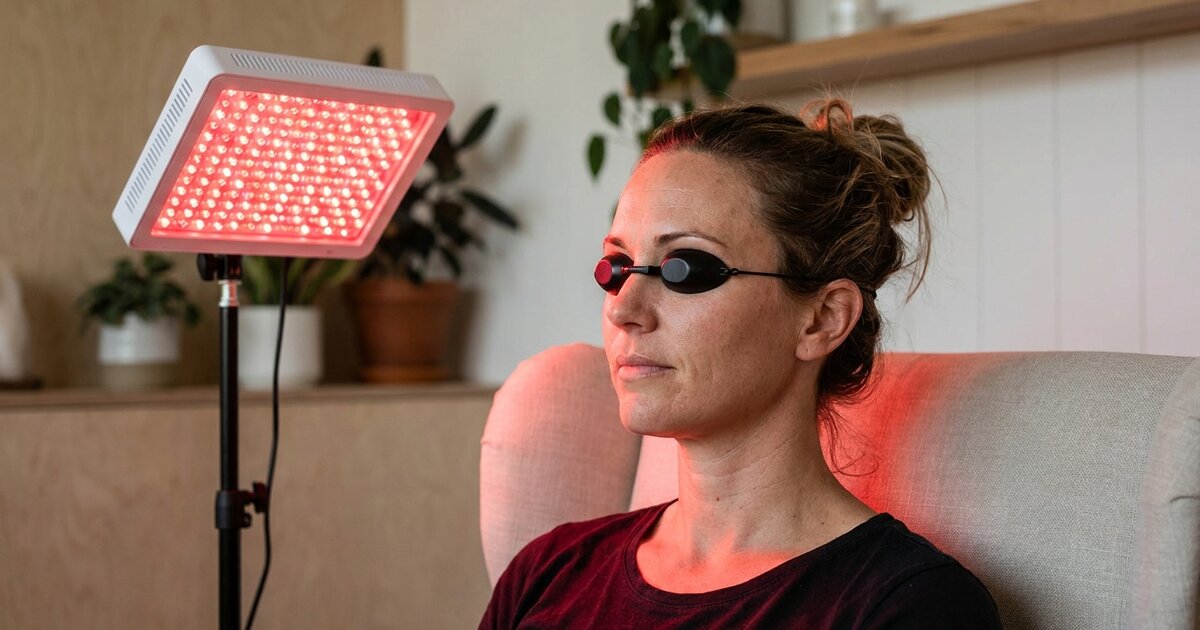
Red light therapy. A bright LED panel, bed, or cap at 630 to 850 nm, used for a set time, sometimes called photobiomodulation. This is about light doing something to your cells. The sleep research here is much thinner.
Both can be useful. They work for different reasons, and the evidence is very different.
Why Red Light Is Easier on Your Clock Than Blue
Your eyes have cells that don't help you see. They track light to set your internal clock, and they're most sensitive to blue.
Two studies published in 2001 mapped this. George Brainard's team at Thomas Jefferson University, in the Journal of Neuroscience, exposed 72 volunteers to single colors of light in the middle of the night and measured melatonin in their blood. Blue light from about 446 to 477 nm suppressed melatonin most. A separate team at the University of Surrey (Thapan and colleagues, Journal of Physiology) found a similar peak near 459 nm.
Longer wavelengths toward red had much weaker effects. That's why a dim red night light is a sensible swap for a bright white bathroom light at 2 a.m.
Two caveats. First, it's not zero. Enough of any light can affect you. Second, brightness matters as much as color. A dim red bulb and a bright red therapy panel are not the same thing.
What the Red Light Therapy Studies Found
The basketball study (2012)
This is the study most red light sellers cite. Researchers at the China Institute of Sport Science gave 10 players from a Chinese army women's basketball team 30 minutes of whole-body red light every night for 14 days. Another 10 players got no light. The results were published in the Journal of Athletic Training.
The red light group improved on the Pittsburgh Sleep Quality Index, a standard sleep questionnaire. Their blood melatonin rose, and they ran farther in a 12-minute run test.
Here's the thing. It was 20 young elite athletes, the comparison group got nothing (no sham device), and the authors described it as a cohort study. It's a fine starting point. It's not strong evidence.
Shift-work nurses (2025)
A randomized trial in the Journal of Nursing Management studied 64 Taiwanese nurses with insomnia who worked rotating shifts. Half wore a cap with 660 nm red and 850 nm near-infrared LEDs for 30 minutes, three times a week, for four weeks. The other half got no treatment.
Insomnia scores dropped much more in the cap group (4.3 vs 12.6 on the Insomnia Severity Index). Depression, anxiety, and stress scores also fell.
Again, some catches. There was no sham cap, so the placebo effect could explain part of it. The device maker supplied the caps for free, and two authors owned stock in the company.
The meta-analysis (2026)
A 2026 review in Lasers in Medical Science pooled five randomized trials with 240 people. Red and near-infrared light improved sleep quality scores by about 1.25 points on the Pittsburgh scale compared with sham. The confidence interval ran from 0.11 to 2.38 points, which is wide. The authors concluded the evidence "remains limited and should be interpreted with caution."
| Study | People | Light | Schedule | Main catch |
|---|---|---|---|---|
| Zhao, 2012 | 20 female basketball players | Whole-body red | 30 min nightly, 14 days | Tiny, no sham |
| Liao, 2025 | 64 shift-work nurses | 660/850 nm cap | 30 min, 3x a week, 4 weeks | No sham, funding ties |
| Meta-analysis, 2026 | 240 across 5 trials | Mixed | Mixed | Small, wide uncertainty |
How It Might Work
No one knows for sure. The main idea is that red and near-infrared light affect mitochondria, the energy centers in cells, and may calm inflammation. The 2026 review also points to changes in blood flow and brain activity. The basketball study found higher melatonin, which could be one route.
The honest read is that the mechanism is plausible, and the human data is early.
A Simple Protocol If You Want to Try It
- Keep evenings dim. This part has the best evidence. After sunset, use warm or red bulbs and turn down screens.
- Pick a time and stick to it. The basketball study used nightly sessions. Finishing 30 to 60 minutes before bed is a practical choice, not a tested one.
- Match the studies. About 20 to 30 minutes, three or more times a week, for at least two to four weeks.
- Protect your eyes. Close them or use goggles. A bright panel is still bright.
- Don't undo it. Don't finish the session and then turn on the overhead lights and scroll your phone.
- Track something. A simple sleep diary works. Note what time you fell asleep, how often you woke, and how you felt in the morning.
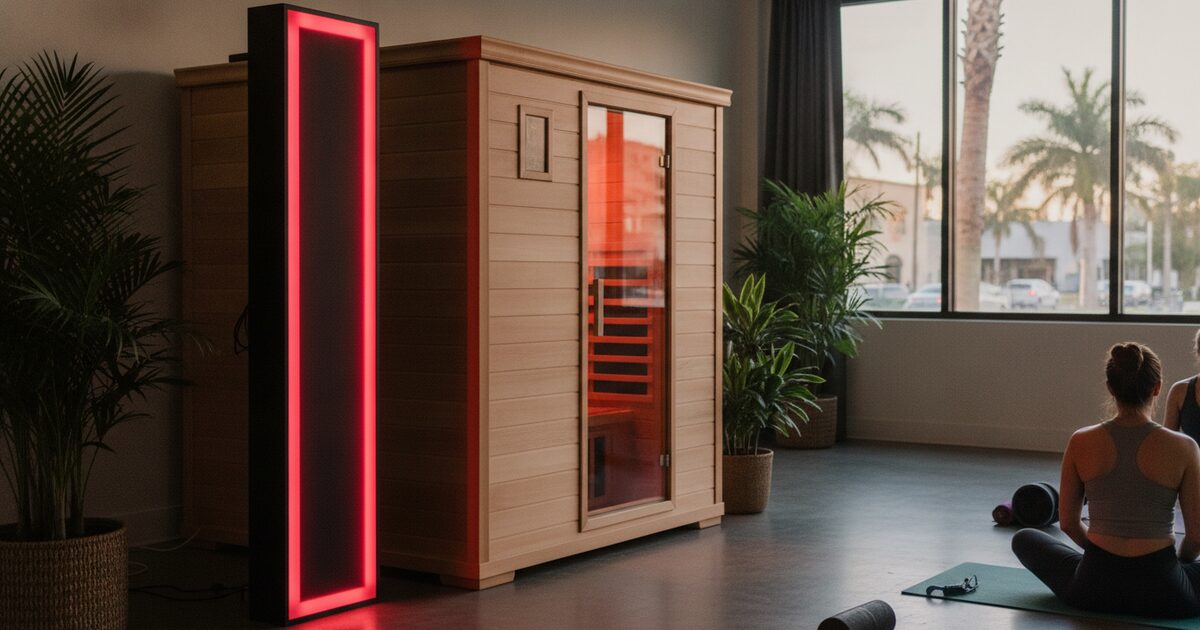
If you already go to a sauna studio in Tampa, an evening red light add-on is cheap. It pairs well with a sauna session one to two hours before bed, which has its own case. See sauna before bed.
For session length and weekly frequency by goal, see how often to do red light therapy.
Who Should Skip It or Ask First
- Anyone with chronic insomnia. If poor sleep has lasted three months or more, start with a doctor. The American Academy of Sleep Medicine's 2021 guideline strongly recommends cognitive behavioral therapy for insomnia (CBT-I) as the first treatment.
- Anyone who snores loudly or stops breathing at night. Sleep apnea needs testing, not a light panel.
- People on light-sensitizing drugs. Some antibiotics, acne medications, and other prescriptions make skin more reactive to light.
- People with eye conditions. Ask an eye doctor before sitting close to a bright panel.
- Pregnancy. Check with your doctor first.
Red vs Other Colors
Blue light has its uses. Bright white light, which is rich in blue, is what light boxes use for morning alertness and seasonal mood problems, and blue LEDs are used for acne. It just belongs in the morning, not at night. For a side-by-side of red, blue, green, and near-infrared, read light therapy colors explained.
Where to Try It in Tampa Bay
Most Tampa recovery studios that run infrared saunas also offer red light panels or full-body beds, often as a low-cost add-on. Compare providers and formats on our red light therapy page before you book. If sleep is the goal, ask for an evening slot. A 7 a.m. session under a bright panel isn't what the studies tested.