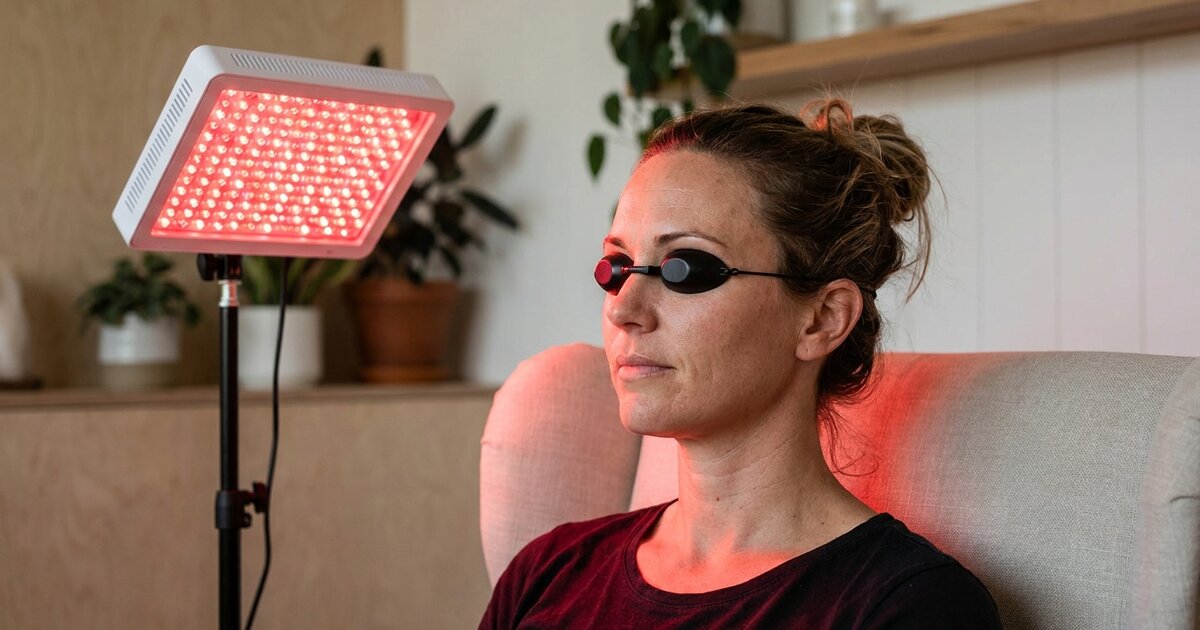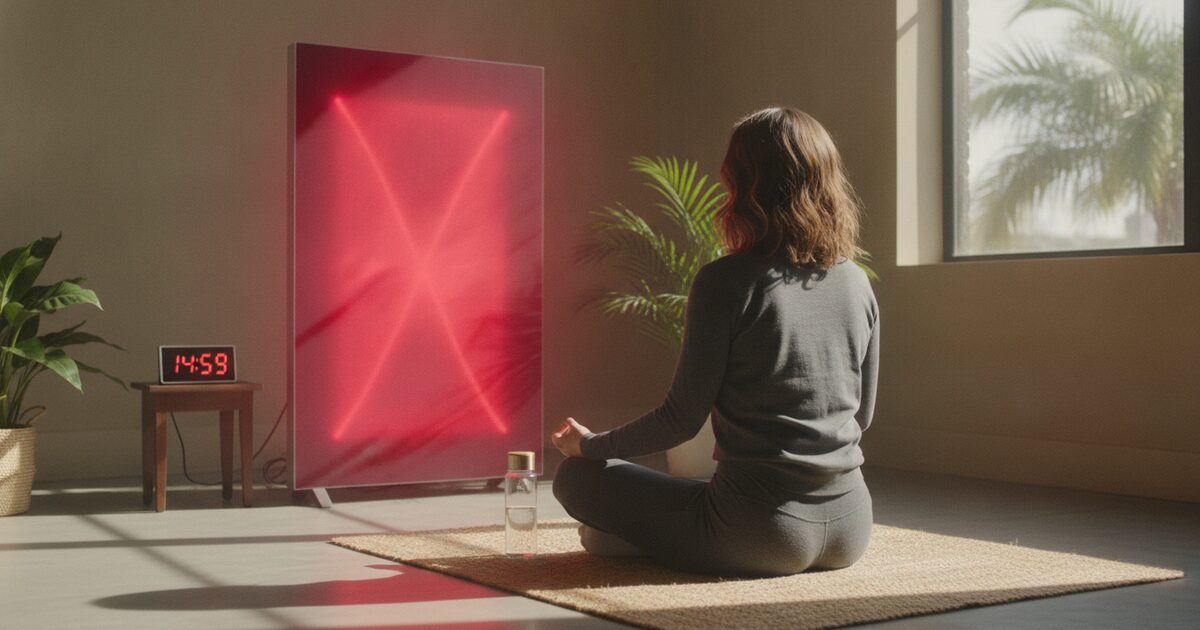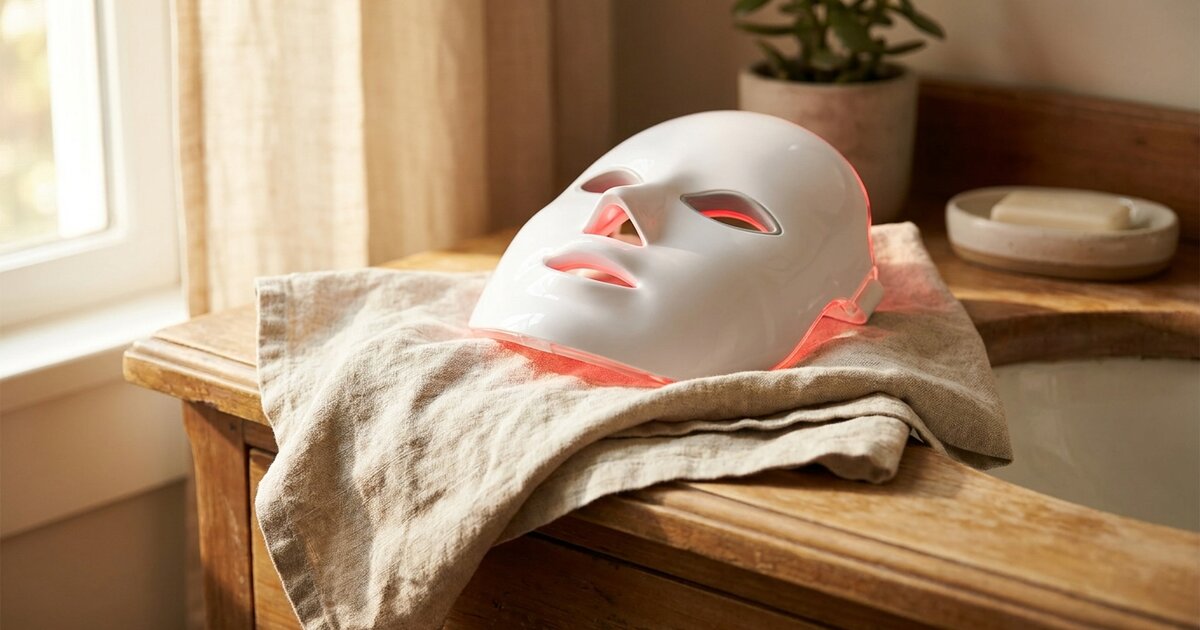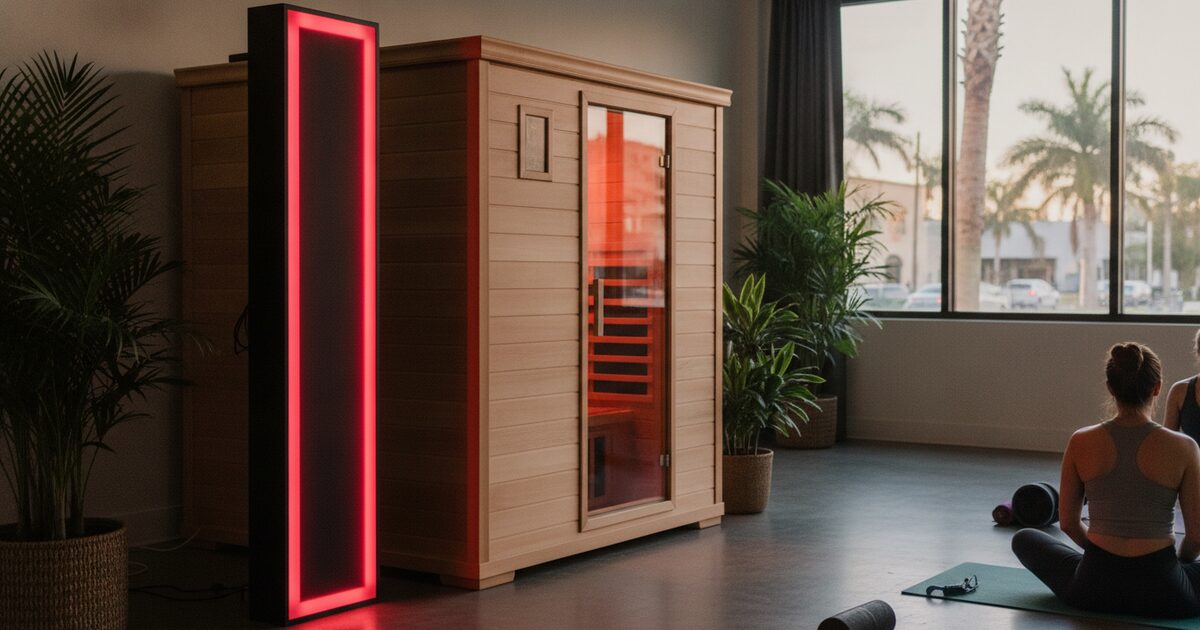
Both machines glow, both say "infrared" on the door, and both show up on the same membership menus across Tampa Bay. That is why people ask which one to book. The two work on your body in different ways, so the better question is what you want out of the session.
Red light therapy is a light dose aimed at skin and the tissue just under it. An infrared sauna is a heat session aimed at your whole body. The rest of this post explains what that difference means for skin, recovery, heart health, cost, and how to combine them.
Side by Side
| Red light therapy | Infrared sauna | |
|---|---|---|
| What it delivers | Red and near-infrared light, about 630 to 850 nm | Radiant heat from infrared heaters |
| How it works | Light absorbed by cells (photobiomodulation) | Raises skin and core temperature |
| Air temperature | Room temperature | Usually 120 to 150°F |
| Session length | Often 10 to 20 minutes | Often 20 to 45 minutes |
| Do you sweat? | Not much | Heavily |
| Strongest evidence | Skin texture, pattern hair loss | Cardiovascular associations (mostly traditional sauna) |
| Typical Tampa price | About $20 to $45 a session | About $25 to $50 a session |
Same Word, Different Wavelengths
Red light panels use two narrow bands. Visible red sits around 630 to 660 nm and near-infrared around 810 to 850 nm. We break those bands down in light therapy colors explained.
Infrared sauna heaters emit mostly long-wave infrared. Those wavelengths are many times longer than anything a red light panel uses. You feel them as warmth, and the point is to heat you.
Some "full spectrum" saunas add near-infrared heat lamps. Many cabins also have colored chromotherapy lights. Those lights are usually low-power LEDs for ambience. They are not the same as standing in front of a treatment panel. If a studio says its sauna lights deliver red light therapy, ask for the irradiance figure. A real treatment panel comes with a spec sheet.
How Each One Works
Red light therapy. Cells absorb red and near-infrared light, mainly through an enzyme in the mitochondria called cytochrome c oxidase. That shifts cell signaling and energy production. Michael Hamblin's review in AIMS Biophysics (2017) lays out the anti-inflammatory side of this. The effect depends on dose: too little does nothing, and a lot more does not work better. We cover dosing in how often to do red light therapy.
Infrared sauna. Heat raises your skin temperature, then your core temperature. Your heart rate climbs, blood vessels near the skin widen, and you sweat. Most of what people report after a sauna comes from that heat load: loose muscles, a calm feeling, better sleep that night. How infrared compares with a traditional hot-rock sauna is covered in infrared sauna vs dry sauna.
By Goal
Skin texture and fine lines
Red light has the better case. In a controlled trial published in Photomedicine and Laser Surgery (Wunsch and Matuschka, 2014), 136 volunteers were randomized to red light groups or controls. The treated groups had two sessions a week for 30 sessions. Blinded photo reviews, skin roughness measurements, and ultrasound collagen density all improved compared with controls.
Sauna studies have not tested this. Heat makes skin flush and look brighter for an hour or so, and then it fades. See sauna and skin health for what sweat and heat do and do not do.
Hair loss
Red light only. Home laser devices have FDA clearance for pattern hair loss. Randomized, sham-controlled trials in Lasers in Surgery and Medicine (Lanzafame, 2013 and 2014) found higher hair counts after 16 weeks of 655 nm treatment every other day. Sauna has no role here. More in red light therapy for hair growth.
Workout recovery
This one is a split decision. A meta-analysis by Leal-Junior and colleagues in Lasers in Medical Science (2015) found that red and near-infrared light improved exercise performance measures. The most consistent effects came when light was applied before exercise. Sauna is usually used after training, for heat exposure and to wind down. Sauna before or after a workout covers the timing.
Heart and blood vessels
This goal favors sauna, with caveats. The best-known data come from a Finnish cohort in JAMA Internal Medicine (Laukkanen, 2015). It followed 2,315 middle-aged men for about 20 years. Men who used the sauna more often had fewer fatal cardiovascular events. That was traditional Finnish sauna, and the study was observational, so it shows an association rather than cause. For infrared specifically, a Japanese trial in Circulation Journal (2016) used a far-infrared dry sauna at 60°C for 15 minutes daily in hospitalized heart failure patients. Walking distance and heart size measures improved. That was a supervised medical protocol, not a spa visit.
Relaxation and sleep
People report both, and sauna usually comes out ahead here. A warm cabin, 30 minutes with no phone, and the cool-down afterward are easier to feel than 12 minutes in front of a panel.
Using Both
You do not have to pick one. Several Tampa Bay providers on our list offer both, including Pause Studio in Midtown, Restore Hyper Wellness in Carrollwood and Westchase, Sage Holistic Spa in Lutz, and MyJourneyMD in Land O' Lakes. Revive Sauna Suites in Wesley Chapel sells them as a package. When we checked its published menu, a 40-minute infrared sauna was $44, a 20-minute red light session $44, sauna plus red light $64, and its "Dual Powerhouse" package $79. Prices change, so confirm before you book.
No trial has tested which order is better. A practical sequence many people use:
- Red light first, on clean, dry skin with no heavy lotion or sunscreen.
- Sauna second, once you are done lying still.
- Rinse and rehydrate.
If you are going for performance, the light research favors using the panel before training, so the sauna fits after.
Cost
Per session, both land in the same range. Red light usually runs about $20 to $45 in Tampa Bay, and infrared sauna about $25 to $50. The difference shows up in frequency. Red light protocols ask for several short sessions a week, so the monthly total adds up faster. Red light therapy cost in Tampa walks through that math. If you go more than twice a week, a membership that covers both usually beats paying per visit.
Who Should Skip Which
Red light: people on photosensitizing medications, and anyone with a light-triggered condition. Wear the goggles for face panels.
Infrared sauna: pregnancy, unstable heart conditions, low blood pressure, recent alcohol, and heat illness in the past. See who should skip the infrared sauna. If one of those applies, red light may be the easier option because it does not add heat stress.
Where to Book Near Tampa
Compare local studios on our red light therapy in Tampa and infrared sauna in Tampa pages. Those pages list which providers offer both.