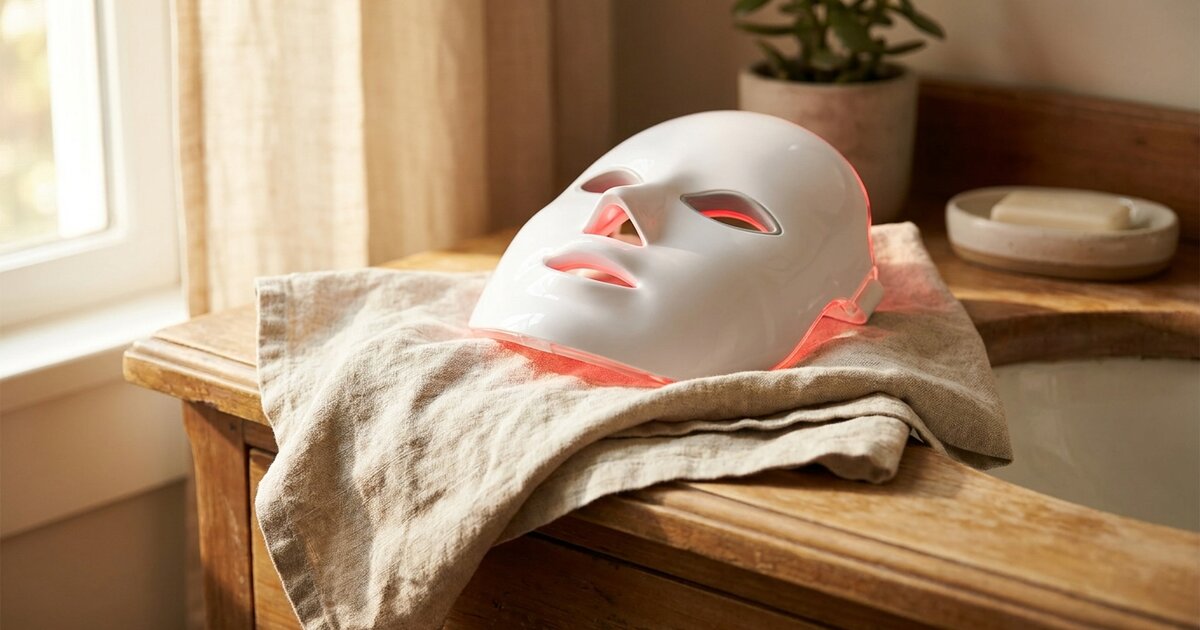
Yes, red light masks can work, but the effect is modest and slow. The best home mask trial found crow's feet improved after 12 weeks of near-daily use. If you're hoping for the results in the ads after two weeks, you will be disappointed.
The rest depends on three things: the wavelengths the mask uses, how much light actually reaches your skin, and whether you wear it often enough. Most people who say masks don't work fell short on the last one.
What the Trials Show for Wrinkles
The clearest study of a home mask is a 2025 trial in Medicine from plastic surgeons at Hanyang University and Seoul National University. Sixty adults aged 30 to 65 with visible crow's feet used either a mask with 630 nm red and 850 nm near-infrared LEDs, or a sham mask. They wore it for 9 minutes, five times a week, for 12 weeks. That comes to 60 sessions.
Independent raters scored the crow's feet better in the real-mask group at 8, 12, and 16 weeks. Only 4 of 60 people reported side effects, mostly dry skin.
Before you treat that as settled, a few caveats:
- It was small. Sixty people, almost all women, all of Asian descent.
- It was industry funded. The study was paid for by Y&J Bio, a Korean company. The authors say the funder did not shape the analysis.
- The sham was not dark. The sham mask emitted red light at one-tenth the strength, with no near-infrared. That makes the comparison stricter in one sense, but it is not a true no-light control.
Older studies point in the same direction. A 2014 controlled trial in Photomedicine and Laser Surgery (Wunsch and Matuschka) gave 113 volunteers two red light sessions a week with large panels. After 30 sessions, blinded raters judged their skin better than controls, and ultrasound showed higher collagen density. That trial used panels, not masks, but it tested the same wavelengths.
What About Acne?
The evidence is weaker here. A 2018 systematic review of 31 randomized LED trials in Lasers in Surgery and Medicine (Jagdeo and colleagues) gave acne a grade B recommendation, meaning the evidence was fair but not strong. The authors noted small samples, missing blinding, and settings that varied from study to study.
A 2016 Cochrane review of light therapies for acne was blunter. It found high-quality evidence lacking and rated the certainty of the results as low. Blue light, or blue and red together, is what most acne studies test. A red-only mask is mostly an anti-aging tool. For how the colors differ, see light therapy colors explained.
Why Masks Are Weaker Than Studio Panels
The number that matters is dose. Dose is power at the skin (irradiance, in milliwatts per square centimeter) multiplied by time.
The mask in the Korean trial was rated at up to 10 mW/cm² per wavelength. Nine minutes at 10 mW/cm² works out to about 5.4 J/cm². The 2014 panel trial normalized its red dose to about 9 J/cm² per session. So the mask made up for lower power by being used five days a week instead of two.
That is the tradeoff with every mask. It sits right on your face, which is convenient, but the LEDs are small and battery-friendly. A studio panel usually puts out more light, so you reach a similar dose in fewer minutes, and it can treat your neck, chest, or whole body at once.
Manufacturer irradiance numbers are hard to compare because brands measure at different distances. If a company won't tell you the irradiance at the distance you'll use it, treat that as an answer. More on the math in how often to do red light therapy.
Wavelength Checklist
When you're comparing masks, look for:
| Spec | What to look for | Why |
|---|---|---|
| Red wavelength | About 630 to 660 nm | Range used in most skin trials |
| Near-infrared | About 830 to 850 nm | Reaches deeper; used in the 2025 mask trial |
| Irradiance | Stated in mW/cm² with a distance | Lets you estimate dose |
| Session time | Stated in minutes | Short sessions only work if you use it often |
| FDA status | 510(k) clearance, usually code OHS | A minimum safety bar |
Extra color modes (green, yellow, purple) add marketing more than evidence. The science behind the red and near-infrared bands is in red light therapy for skin and recovery.
FDA-Cleared Does Not Mean FDA-Approved
Many masks advertise "FDA cleared." Most are cleared through the 510(k) process under product code OHS, which the FDA database lists as "light based over the counter wrinkle reduction."
A 510(k) clearance means the FDA agreed the device is substantially equivalent to a device already on the market. It is not the same as approval, and it does not rank one mask against another. It does screen out some poorly built products, so it is a reasonable minimum bar.
Eye Safety
Masks sit an inch from your eyes, so this matters.
In July 2019, Johnson & Johnson recalled the Neutrogena Light Therapy Acne Mask in the US and Canada. Health Canada posted it as a voluntary recall made "out of an abundance of caution." According to C&EN, the company pointed to a theoretical risk of eye injury for people with certain underlying eye conditions or those taking light-sensitizing drugs such as doxycycline. Reported symptoms included eye pain, tearing, blurry vision, and seeing spots, and they went away when people stopped using it. Complaints came in on about 0.02 percent of masks sold. That mask used blue light, which carries more concern for the retina than red.
Practical rules:
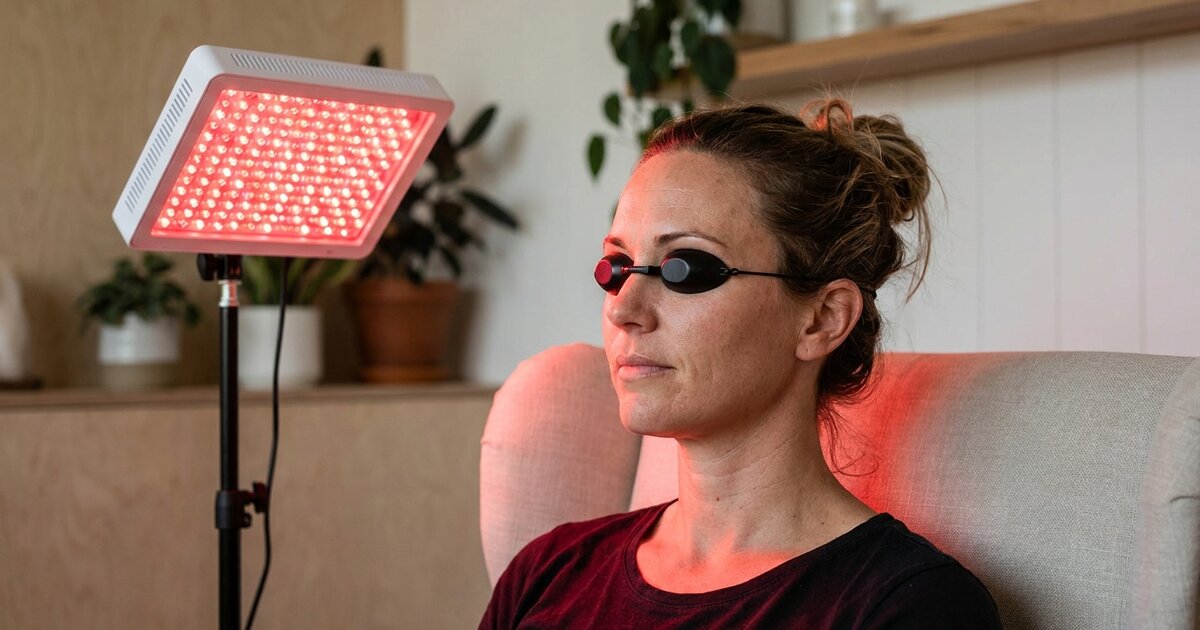
- Keep your eyes closed, and wear the goggles if the mask comes with them.
- Check your medications. Some antibiotics, acne drugs, and other prescriptions make you more sensitive to light.
- If you have an eye condition, a history of retinal problems, or a seizure disorder triggered by light, ask your doctor before using one.
- Skip sessions over a fresh sunburn or an active rash.
Mask vs Studio: The Tampa Cost Math
Single red light sessions in Tampa Bay generally run $20 to $45, based on our red light therapy cost in Tampa breakdown. The popular Omnilux Contour Face mask listed at $395 on the Omnilux site in September 2026.
| Plan | Sessions | Rough cost |
|---|---|---|
| Studio, twice a week at $30 | About 8 to 9 a month | $240 to $270 a month |
| Mask at $395 | Unlimited, face only | Break-even at about 13 studio sessions |
| Trial schedule (5 a week, 12 weeks) | 60 sessions | Only realistic at home |
So a mask wins on price if you use it, and only a home device makes a five-days-a-week schedule practical. A studio makes more sense if you want your neck, chest, or body treated too, or if you're already going for the sauna and can add red light for less.
Many people in Tampa end up doing both: a mask for the face on weeknights, and a full-body panel at a studio once a week.
What Results to Expect
Be realistic. In the trials, changes were gradual and measured with grading scales, not the kind of before-and-after you see in ads. Fine lines, texture, and tone move a little. Deep wrinkles, sagging, and sun spots mostly don't. For honest photos and timelines, read red light therapy before and after.
Give it 12 weeks before you decide. Take photos in the same light at the start and every four weeks.
Trying It Before You Buy
If you want to know whether you like red light before spending $400 on a mask, try a few studio sessions first. Compare local providers and prices on our red light therapy in Tampa page. Ask each one what irradiance their panel delivers at the distance you'll sit.