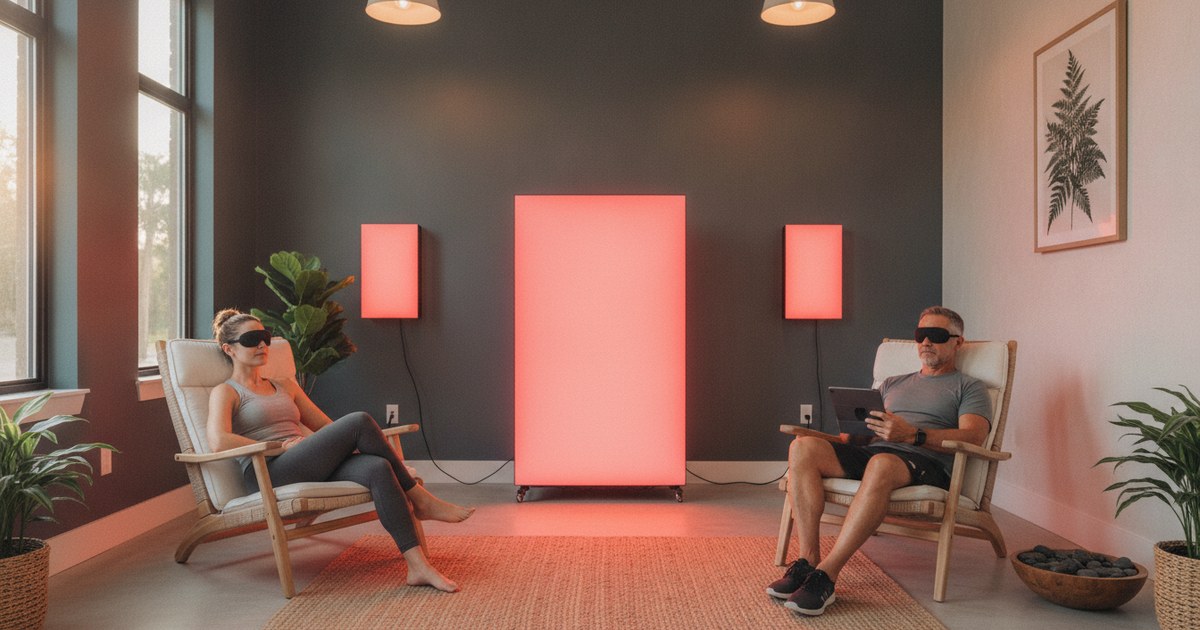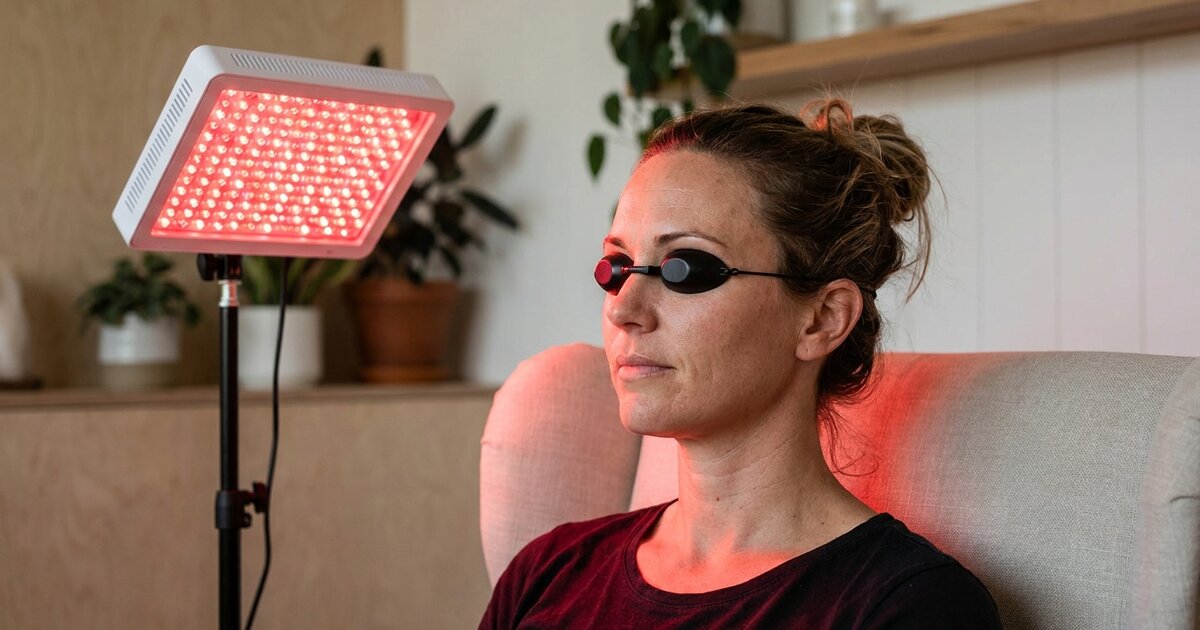
Near-infrared light therapy uses light just beyond the visible red part of the spectrum. You may see it abbreviated as NIR. Some devices combine NIR and visible red light in the same panel or mask, so the red glow does not tell you which wavelengths you receive.
Researchers use the term photobiomodulation, or PBM, for certain light-based interventions. Evidence depends on the device, dose, treatment schedule, and condition under study. A wavelength printed on a Tampa studio's menu does not establish that the session will treat pain or improve recovery.
Red light versus near-infrared
| Question | Red light | Near-infrared light |
|---|---|---|
| Can you see it? | Yes, it appears red | NIR itself is outside the visible range |
| Common device examples | Devices may list wavelengths such as 630 or 660 nm | Devices may list wavelengths such as 810, 830, or 850 nm |
| Is the wavelength enough to choose a treatment? | No; dose, device design, and evidence matter | No; the same questions apply |
| Does the treatment need to feel hot? | Heat is not a required sign that PBM is working | Lack of visible light or heat does not tell you the delivered dose |
These are examples, not recommended settings. Light absorption and scattering vary with wavelength and tissue. Avoid claims that a panel always penetrates a fixed number of centimeters or reaches every painful joint.
If you are comparing a light session with heat, see red light therapy versus infrared sauna. The word "infrared" appears in both services, but the exposures differ.
What does near-infrared light do?
A 2017 review in AIMS Biophysics describes proposed PBM mechanisms, including light absorption by cellular components, changes in signaling, and effects on inflammation in experimental models. The review also describes a dose response in which more light does not necessarily produce a better effect.
Those mechanisms help researchers form hypotheses. They do not prove that a consumer device delivers enough light to the relevant tissue or that a studio protocol reproduces a clinical trial.
The practical questions are more specific than "Does NIR work?":
- What outcome did researchers measure?
- Did they test the same type of device and exposure?
- Did participants have the same problem you want to address?
- Did researchers compare treatment with a credible control?
A study of a targeted device on one body part does not validate an unrelated whole-body session. Ask for evidence that matches the service rather than a list of articles mentioning infrared light.
What studies support for skin and recovery
In a 2014 controlled trial in Photomedicine and Laser Surgery, researchers enrolled 136 volunteers. They assigned 113 to light-treatment groups and compared them with 23 controls. After 30 sessions, treated participants showed improvements in measured skin roughness, collagen density, and photographic assessments.
The broader-spectrum treatment did not outperform the red-only spectrum. That finding does not support the claim that adding more wavelengths always makes a skin treatment better. The study also does not establish that an arbitrary panel setting will reproduce the results.
A 2018 systematic review in Lasers in Surgery and Medicine evaluated 31 randomized trials of LEDs in dermatology. The authors described encouraging findings for some uses, but also small samples, missing blinding, and treatment parameters that differed between studies.
For exercise recovery, a 2025 systematic review found low-certainty evidence that PBM applied before exercise reduced muscle soreness. That is a qualified finding about the tested protocols, not proof that a general NIR session after any workout improves performance.
For facial devices, the red light mask guide separates trial findings from marketing. Neither a panel's size nor its professional setting guarantees faster results than a home device.
Red light therapy for eczema: check which light treatment you mean
Medical phototherapy and wellness LED sessions are different services.
The American Academy of Dermatology's eczema phototherapy guidance describes ultraviolet light under medical supervision. The dermatologist controls the exposure and considers the patient's history and possible side effects. That is not the same intervention as a red or near-infrared panel at a recovery studio.
Do not infer that red light treats eczema because a provider calls both services "light therapy." Ask your dermatologist whether any device fits your care plan, particularly during a flare or if you use medication that changes light sensitivity. Do not delay prescribed treatment while testing a wellness device.
The same caution applies to claims about treating burns, open wounds, or persistent rashes. Clinical wound research does not make a general studio session an appropriate substitute for evaluating an injury.
Dose: the specifications to ask for
Ask a provider for more than the color names:
- Wavelengths: the numerical values in nanometers, rather than "full spectrum."
- Irradiance at your position: light power per unit area, often stated in mW/cm², at the distance you will use.
- Exposure time and coverage: which body areas receive light, and for how long.
- Instructions and evidence: the manufacturer's protocol and the evidence supporting the intended use.
Irradiance multiplied by time gives an estimate of surface energy density. It does not tell you the dose reaching a deep tissue or prove clinical benefit. Different measurement methods and distances can make manufacturer numbers hard to compare.
Do not extend sessions or move closer to the panel to chase a higher dose. See how often to use red light therapy for more on schedules and device instructions.
Safety before a first session
Tell the provider about medications and skin or eye conditions. Ask your clinician or pharmacist about light sensitivity when relevant, and follow the device's eye-protection instructions. Invisible NIR is not a reason to stare at a panel.
Do not assume closing your eyes substitutes for required protective equipment. Ask what protection the manufacturer specifies and whether the provider supplies it. Stop and report eye discomfort, worsening skin irritation, or unexpected heat.
If you want to treat a diagnosed condition, discuss the device with the clinician who manages it. A wellness session should not delay care for persistent pain, a changing skin lesion, or another unexplained symptom.
Comparing light therapy in Tampa
Compare red light therapy providers in Tampa and ask whether the location offers visible red, NIR, or a combination. Confirm the exact device before buying a package; a service label alone does not answer that question.
Check whether the booking is a targeted treatment, a whole-body panel, or an add-on to another service. Ask about preparation, eye protection, distance, and the total appointment length. A convenient South Tampa location may suit your schedule, but convenience does not establish a better clinical result.
Use the Tampa light therapy cost guide to compare pricing questions. Start with the service that matches your goal and the evidence, rather than paying for extra colors or a promise that "deeper" light must be better.