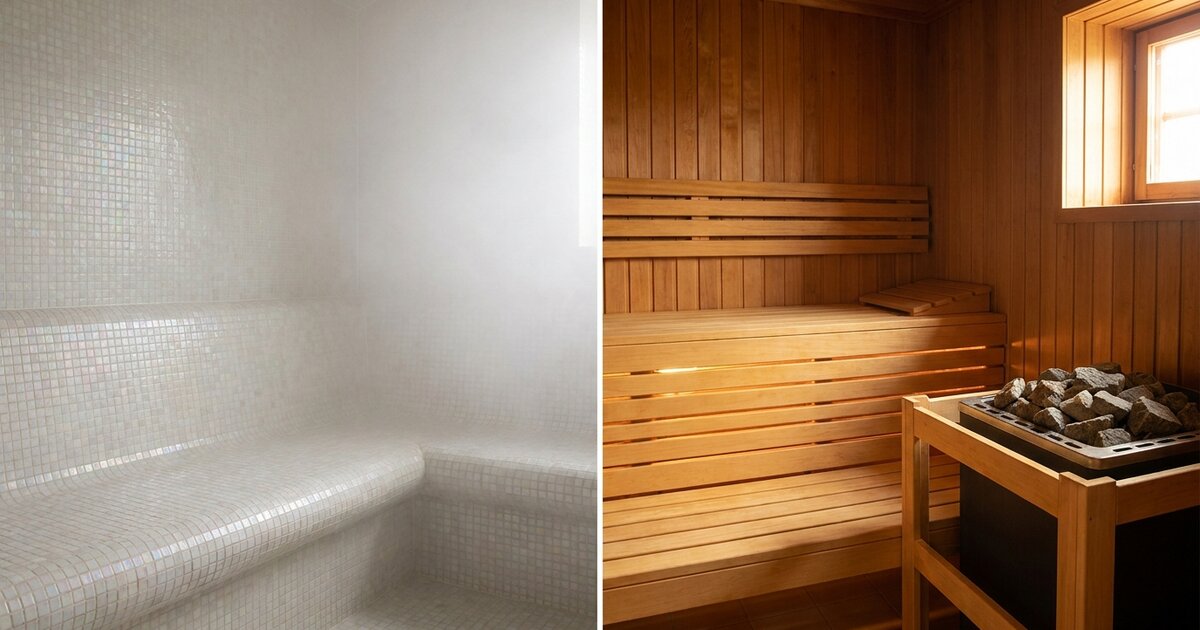
A sauna heats you with hot, dry air. A hot tub heats you with water. Water moves heat into your body far faster than air does, and it presses on you from every side. So a 104°F hot tub can warm you up as quickly as a 180°F sauna, and it does a few things a sauna can't.
Short version: the sauna has the stronger long-term health research, the hot tub is easier on stiff joints and more social, and both carry real risks if you overdo them.
Sauna vs hot tub at a glance
| Traditional sauna | Hot tub | |
|---|---|---|
| Heat source | Hot air, about 150 to 195°F (65 to 90°C) | Hot water, usually 100 to 104°F (38 to 40°C) |
| How fast your core warms | Slower; sweat evaporates and cools you | Faster; sweat can't cool you underwater |
| Pressure on the body | None | Water pressure pushes blood from legs toward the chest |
| Long-term research | Large Finnish cohort studies | One large Japanese cohort on tub bathing |
| Main safety concerns | Dehydration, fainting, low blood pressure on standing | Overheating, drowning with alcohol, water-borne germs |
| Upkeep at home | Low; no water | Chemicals, filters, water testing |
The 104°F ceiling isn't arbitrary. The U.S. Consumer Product Safety Commission says hot tub water should never go above 104°F and treats 100°F as safe for a healthy adult. It also notes that thermostats can be off by as much as four degrees.
Why hot water heats you faster
In a sauna, your skin is surrounded by air. Air is a poor conductor, and as long as your sweat evaporates, your body sheds heat. In a hot tub, the water at your skin is warmer than you are, water conducts heat well, and sweat just mixes into the tub. Nothing cools you.
A small 1981 study in the Canadian Medical Association Journal measured this directly. Twenty non-pregnant women sat in hot tubs set to 39°C (102°F) or 41.1°C (106°F) and in a sauna averaging 81.4°C (178°F). Some reached a core temperature of 38.9°C in the tubs, though none did so before 15 minutes at 39°C or before 10 minutes at 41.1°C. None of the women stayed in the sauna long enough to reach 39.9°C. Most left because they were uncomfortable, which is the sauna's built-in safety valve: dry air at that temperature makes you want to leave before you're in real trouble.
The hot tub's comfort works against you here. It feels nice for a long time, which is why people fall asleep in them.
What water pressure adds
When you sit in water up to your chest, the water pushes on your legs and belly. That shifts blood from your legs toward your chest and heart, and your heart pumps a bit more per beat. A 2009 review of aquatic therapy physiology in PM&R describes these immersion effects and why they're useful in rehab.
For recovery, that pressure plus buoyancy is the hot tub's real advantage. Your weight comes off your joints, and moving a stiff knee or back feels easier underwater. If arthritis or a sore back is your main reason for using heat, that's worth a lot. It's also why a sauna can feel better for some people and a hot tub for others with the same complaint. The sauna side of this is in sauna for joint pain.
What the long-term research says
Sauna. The Kuopio study in eastern Finland followed 2,315 middle-aged men for a median of about 21 years. In the 2015 paper in JAMA Internal Medicine, men who used a sauna four to seven times a week had about a 63 percent lower rate of sudden cardiac death than men who went once a week, after adjusting for other risk factors. The full picture, including dementia follow-ups, is in the Finnish sauna research post, and the heart side is in sauna and heart health.
Hot water bathing. The closest match for hot tubs is Japan, where soaking in a deep hot bath is a daily habit for many people. A 2020 study in Heart followed 30,076 Japanese adults aged 40 to 59 for about 20 years. People who took a hot tub bath almost every day had a 28 percent lower risk of cardiovascular disease than people who bathed zero to two times a week, after adjusting for other risk factors. The researchers saw no link with sudden cardiac death.
Both are observational. People who can take a daily sauna or bath may differ from those who don't in ways the adjustments miss. And a Japanese home bath isn't a backyard hot tub with jets, but it's the best evidence available on regular hot water immersion.
Safety: where each one goes wrong
Overheating and alcohol. This is the big hot tub risk. The CPSC has long warned that hot water can make people drowsy, that drinking raises the risk of losing consciousness and drowning, and that soaking in 106°F water can push a healthy adult toward heat stroke. The sauna has the same alcohol problem, just without the water to drown in.
Blood pressure drops. Both lower blood pressure while you're in them, which is why people feel woozy standing up. Japan shows how serious this gets for older people. A 2022 review in the Journal of Physiological Anthropology estimated that about 19,000 Japanese people die each year while bathing, mostly elderly people in winter, often after a sudden drop in blood pressure leads to fainting and drowning.
Germs. Dry sauna heat gives germs little to work with. Warm water is different. Poorly kept hot tubs can grow Pseudomonas, which causes an itchy rash known as hot tub folliculitis, and Legionella, which causes a serious pneumonia. CDC investigators traced two Legionnaires' disease outbreaks between 2022 and 2024 to private balcony hot tubs on cruise ships. At a venue, clear water and a mild chlorine smell are good signs. Cloudy water, slimy edges, or a strong chemical smell are not.
Pregnancy. The worry is high core temperature in early pregnancy. The CPSC tells pregnant women to keep hot tub water at or below 100°F. The 1981 study above suggests a hot tub raises core temperature faster than a sauna. Either way, ask your obstetric provider first.
Heart conditions and medications. If you have heart disease, uncontrolled blood pressure, a history of fainting, or take medicines that affect blood pressure or cause drowsiness, talk to a clinician before using either. Who should skip the sauna covers the details for heat in general.
Which one should you pick?
- Stiff joints or a sore back: hot tub, for buoyancy and water pressure.
- Research-backed routine for heart health: sauna.
- Hot and cold contrast with a cold plunge: sauna, which is what most contrast therapy studios pair with a plunge.
- Relaxing with other people: hot tub, since talking in a hot sauna gets old fast.
- You're prone to falling asleep or like a drink while you soak: sauna, and skip the drink.
If you already use one, you don't need to switch. You'll probably get more from using it regularly than from changing formats.
What each costs in Tampa: own it or visit
Owning either is a real commitment. Angi puts the average hot tub at about $6,000, with small tubs from about $2,000 and large ones over $20,000, plus roughly $20 a month in electricity for an aboveground tub. Chemicals and filters add more. HomeGuide lists an installed infrared sauna at $2,300 to $8,500 and an installed prefab outdoor sauna at $5,500 to $14,500. A sauna needs no water chemistry, which counts in Florida's heat and pollen.
Visiting is cheaper while you figure out which you like. Prices below come from each venue's own website, checked in September 2026:
- Shangri-La Bath & Sauna, East Tampa (5636 East Hillsborough Avenue) lists hot tubs, cold tubs, sauna rooms, and steam rooms, all covered by a $35 day fee. It's the easiest way to try both in one afternoon.
- Nordic Spa Klub, St. Petersburg lists traditional and infrared saunas plus cold plunges at $50 for a single entry, or $35 for a first visit.
More options are in the Tampa Bay bathhouse guide and on the infrared sauna options in Tampa page. If you're weighing wet heat against dry heat more generally, steam room vs sauna covers the in-between option.