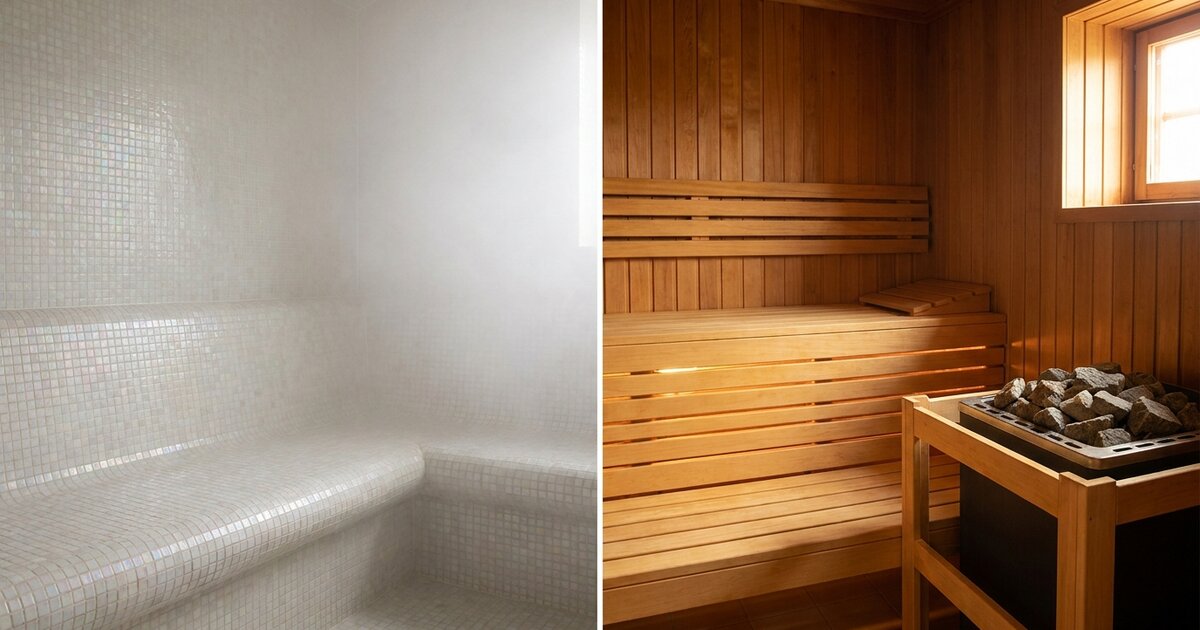
A steam room is cooler than a sauna but feels just as intense, because the air is so wet that your sweat has nowhere to go. A sauna is hotter and dry. That one trade, temperature versus humidity, explains most of the difference in how they feel, what they seem to do, and who likes which.
The practical answer for most people: use the sauna if you want the routine with decades of research behind it, and use the steam room if dry heat irritates your nose, throat, or skin. Plenty of people use both.
Steam room vs sauna at a glance
| Traditional sauna | Steam room | |
|---|---|---|
| Air temperature | About 150 to 195°F (65 to 90°C) | About 105 to 160°F (40 to 70°C) |
| Humidity | Low, roughly 5 to 25 percent; rises briefly when water hits the rocks | Near 100 percent |
| How you lose heat | Sweat evaporates, which cools you | Sweat can't evaporate, so it just runs off |
| What it feels like | Sharp heat on your face, dry breathing | Heavy, enveloping warmth, wet skin, foggy air |
| Typical session | 10 to 20 minutes | 10 to 15 minutes |
| Research base | Large, including 20+ year Finnish cohort data | Small |
The sauna numbers match how Polish researchers described a dry sauna in a 2014 study in Biology of Sport: 80 to 100°C with 5 to 25 percent humidity. They described the wet steam bath, or Russian banya, as 40 to 70°C air fully saturated with steam. Temperatures vary by venue, so check the thermometer if there is one.
If you're really choosing between infrared and a regular dry sauna, that's a different comparison. It's covered in infrared sauna vs dry sauna.
Infrared sauna vs steam room: choosing your first session
Choose an infrared sauna if you prefer dry air and a cabin where you can ask staff to adjust the heat. Choose a steam room if you enjoy humid warmth. Neither format has a proven advantage for treating stress, losing body fat, or removing toxins.
| Infrared sauna | Steam room | |
|---|---|---|
| Heat source | Infrared panels deliver radiant heat to your skin | A steam generator heats and humidifies the room |
| Air and sweat | Dry air allows more sweat evaporation | High humidity limits sweat evaporation |
| Temperature example in Tampa | Grand Beauty Spa lists approximately 150°F | The same venue lists 100–115°F |
| Room setup | Ask whether your cabin is private or shared | Ask whether the steam room is private or shared |
| Booking detail | Check whether you can adjust the temperature | Check the room temperature and whether you can leave and reenter |
Those temperatures come from Grand Beauty Spa's contrast-therapy page, checked October 1, 2026. They describe that venue, not every sauna or steam room. See the sauna temperature guide for other heat formats.
Does infrared have better health benefits than steam?
The evidence does not establish a winner. Researchers often study traditional Finnish saunas, medical heat treatments, or hot-water immersion. You cannot assume the same results apply to an infrared cabin or a steam room.
In a 2014 study in Biology of Sport, ten healthy men experienced greater heat strain in a wet sauna than in a hotter dry sauna. Researchers did not test an infrared cabin. The useful caution is that humid heat can put substantial strain on your body despite a lower thermometer reading.
Choose by how you feel, rather than by how much you sweat. If either room makes you dizzy, nauseated, or short of breath, leave. Ask a clinician before trying heat if you have heart disease, blood pressure problems, a history of fainting, or are pregnant.
Trying both in Tampa without buying a membership
At 2717 West Kennedy Boulevard, Grand Beauty Spa lists a private room with infrared sauna, steam room, and cold plunge access. Its published non-member prices are $65 for 45 minutes and $75 for an hour, checked October 1, 2026. Confirm the current rate, guest policy, and booking availability with the spa.
Your reservation covers access time, not a target for time spent in the heat. Leave time to shower, rest, and get dressed. You can skip the cold plunge; it is not necessary for comparing the two heat formats. For a first visit, ask staff to help you plan a short session rather than trying to fill the reservation with heat exposure.
Compare other sauna providers in Tampa before booking. Ask whether the location offers infrared, traditional sauna, or steam: providers sometimes use the word "sauna" for different setups.
Why a cooler steam room can feel harder
Here's the part that surprises people. The steam room can be 50 or more degrees cooler, and it can still push your body harder.
Your main way of shedding heat is sweat evaporating off your skin. In a dry sauna that works well, so your skin stays cooler than the air. In a steam room the air is already saturated, so evaporation mostly stops. Your core temperature climbs even though the thermometer on the wall looks mild.
That same 2014 study put ten healthy young men through both. Each did three 15 minute rounds, once in a dry sauna averaging about 91°C (196°F) and once in a steam bath averaging about 59°C (138°F) at 60 percent humidity. Results:
- Rectal temperature rose by 1.61°C in the steam bath versus 1.16°C in the dry sauna.
- Heart rate rose more in the steam bath.
- The men lost about twice as much body mass (mostly water) in the dry sauna, 0.72 kg versus 0.36 kg, because their sweat was actually evaporating.
- They rated the steam bath as more uncomfortable, and the researchers' heat strain scores were higher for it.
Ten people is a small sample, and one study isn't the last word. But the direction makes sense physiologically: wet heat is the more stressful of the two at the temperatures people actually use.
Steam room benefits: what the evidence says
"Steam room benefits" searches promise a lot. The honest version is shorter.
Breathing and colds. Warm, humid air feels good in a stuffy nose, and that feeling is real. Whether it helps you recover is a different question. A 2017 Cochrane review of heated, humidified air for the common cold found six small trials and could not show a clear benefit or harm. If you're sick, a steam room isn't treatment, and you'll be sharing air with everyone else. The same logic applies to saunas, which is covered in can a sauna help a cold.
Sore muscles. A 2013 study from Loma Linda University in the Journal of Clinical Medicine Research gave 100 people squat-induced muscle soreness, then treated them with either moist or dry heat wraps. Moist heat applied right after exercise gave the most pain relief, in a quarter of the application time. That was heat packs on the thigh, not a steam room, so treat it as a hint rather than proof. Still, it matches what a lot of people report after a steam session.
Skin. Steam makes skin look flushed and dewy for a while, and sweat plus humidity softens the outer layer. There's no good controlled research showing a steam room improves skin long term. There is a little on saunas: a 2008 controlled study in Dermatology compared regular sauna users with non-users among 41 healthy volunteers. Regular users had a more stable skin barrier and better skin hydration than non-users. It's small and exploratory, but it's more than steam has. More on that in sauna for skin.
Relaxation. Both work. Pick the one you'll actually sit in.
Sauna benefits, briefly
The sauna's advantage is the depth of the evidence. The Kuopio study in eastern Finland followed 2,315 middle-aged men for a median of about 21 years. In the 2015 paper in JAMA Internal Medicine, men who used a sauna four to seven times a week had about a 63 percent lower rate of sudden cardiac death than men who went once a week, after adjusting for other risk factors. That's observational data from traditional Finnish saunas, so it shows association, not cause. Nothing comparable exists for steam rooms. The details are in the Finnish sauna research post.
Which one should you pick?
- You want the most research-backed routine: sauna.
- Dry heat makes your nose, throat, or eyes sting: steam room, or a sauna where you can add water to the rocks.
- You're new to heat: either, but keep the steam room short. It sneaks up on people.
- You're doing contrast therapy with a cold plunge: sauna is the usual pairing, and it's what most Tampa contrast studios offer.
- You have heart disease, blood pressure problems, a history of fainting, or you're pregnant: ask a clinician first. Given the 2014 data, don't assume the "cooler" steam room is the gentler option.
Session length works the same way for both: start short, stand up slowly, and leave if you feel dizzy, nauseated, or your heart is pounding. How long to sit in a sauna has a beginner plan.
Hygiene: the steam room's weak spot
A sauna's dry heat doesn't give much to germs. A steam room is warm and wet all day, which is a friendlier environment for mold and bacteria if the room isn't cleaned well. You don't need to be paranoid, but be picky:
- Look at the grout and corners. Black spots and a musty smell are a no.
- Sit on a towel and wear sandals.
- Shower before you go in, which most venues require anyway.
- Don't go in with an open cut or a new tattoo.
- Skip it when you're sick, for your sake and everyone else's.
Where to find a steam room or sauna in Tampa Bay
Tampa has plenty of saunas. Steam rooms are harder to find outside gyms and hotel spas. Here are three places that list both, checked on their websites in September 2026:
- Shangri-La Bath & Sauna, East Tampa. A Korean-style bathhouse at 5636 East Hillsborough Avenue. Its facility page lists sauna rooms, steam rooms, hot tubs, and cold tubs, all covered by a $35 day fee ($30 under 12, $28 over 75). Scrubs and massage cost extra. It's the easiest way to try both rooms in one visit.
- Grand Beauty Spa, Kennedy Boulevard. At 2717 West Kennedy Boulevard, a private session includes an infrared sauna, a steam room, and a cold plunge. Its service page lists $65 for 45 minutes or $75 for an hour for non-members, checked October 1, 2026.
- Safety Harbor Resort & Spa, Safety Harbor. At 105 North Bayshore Drive, the resort spa lists steam rooms, saunas, whirlpools, and a ladies' plunge pool among its amenities. Access pricing isn't listed on its spa page, so call ahead.
If you only want dry heat, the infrared sauna options in Tampa page and the Tampa Bay bathhouse guide cover studios with traditional and infrared saunas, many with cold plunges. Many gyms also have steam rooms. Check the amenities list for your location before you assume one is there.
If you plan to combine heat with movement, read sauna stretches and first-visit precautions before treating a cabin as an exercise space.