Sore Knee, Three Doors, One Hour
A guy props himself on the front counter with a knee that has been complaining for about a month. He has read enough to know the studio has PEMF, red light, and compression boots. He asks which one he should book.
The answer he usually gets is some version of all of them.
Sometimes that is genuine enthusiasm from someone who likes all three. Sometimes it is a package. Either way it is close to useless for a person with one sore joint, one free hour, and a budget that is not infinite.
Studio menus are organized by equipment. You arrive with a symptom and you are asked to shop by machine. Nobody at the counter can do that translation for you in the ninety seconds before your appointment starts, so it helps to have sorted it out before you walk in.
What follows is the sorting. The branches are questions about your joint, not descriptions of hardware.
First Question: Is It Swelling Or Is It Stiffness?
Most people skip this fork, and it is the one that matters most.
Swelling shows up. The sock leaves a deeper line on one side. The joint feels tight in a way that shifts over the day, worse after a long stretch on your feet, quieter in the morning. Ankles and knees announce it most clearly.
Stiffness is a different complaint. The joint does not want its full range first thing. It needs ten minutes and some movement before it feels like it belongs to you again. It might look completely normal the whole time.
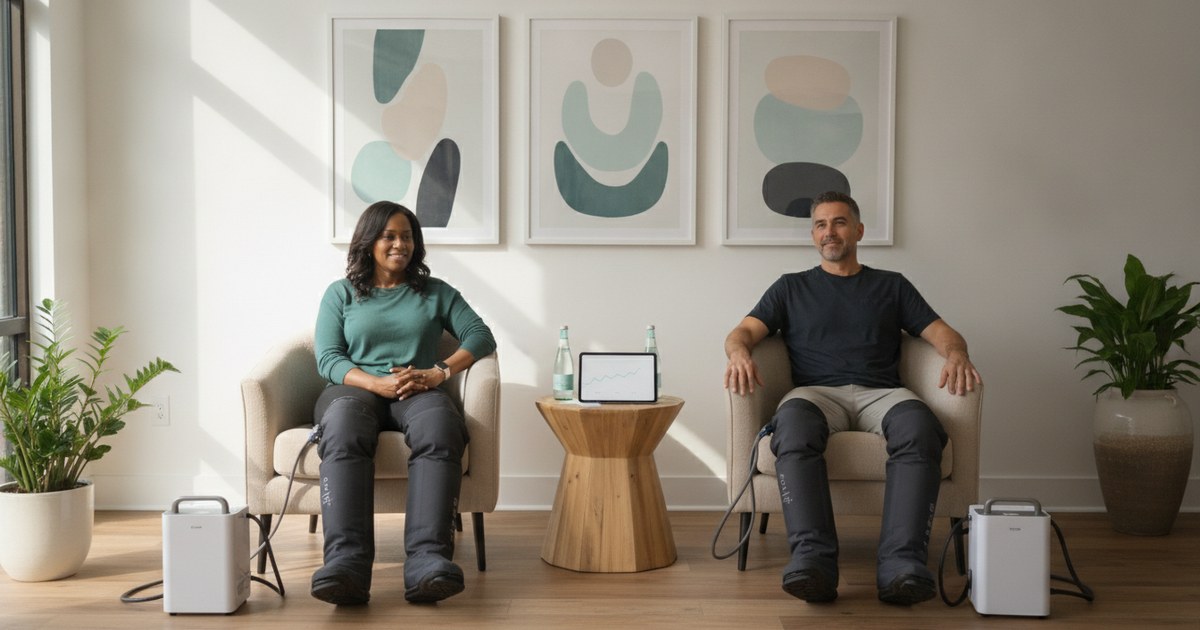
If the honest answer is swelling, compression is the sensible first try. Sequential compression is a mechanical tool doing a mechanical job, which is moving fluid along. People report the leg feeling lighter afterward and the sock line being less obvious for a few hours.
If the answer is stiffness, compression tends to feel pleasant and somewhat beside the point. That branch runs toward warmth and toward PEMF. For the heat version of the argument, sauna for joint pain and arthritis covers where warmth fits with joints that do not want to move in the morning.
Plenty of joints are both swollen and stiff. In that case start with the swelling, because it is the one where you can actually see whether something changed.
Second Question: Surface Or Deep?
Light does not travel far into tissue. That is not a knock on red light, it is just physics, and it sets the boundary of where the modality is plausible at all.
If what hurts sits close to the surface, a tender patch over a tendon, skin that is unhappy after a procedure, a spot you can cover with one finger, red light is in the right neighborhood. The mechanisms and the reasonable expectations are laid out in the science of red light therapy for skin and recovery.
If what hurts is inside the joint, the ache under the kneecap or deep in the hip, red light is being asked to reach somewhere it does not go. That is the branch where PEMF comes up, since a magnetic field passes through clothing and tissue in a way visible light does not. What people report after PEMF on a deep sore joint is usually described as a loosening or a quieting rather than anything dramatic. The longer write-up is PEMF therapy for arthritis and joint pain.
Worth saying plainly: the evidence base under all of this is uneven, and PEMF in particular carries more marketing than settled science. Treat the mechanism as a reason to try something, not as a promise about the outcome.
Third Question: How Much Time Are You Willing To Give It?
This decides more bookings than either question above, and almost nobody asks it out loud.
Compression is passive and quick. Twenty to thirty minutes, boots on, phone in hand, done. It repeats easily and slots into a normal week without renegotiating your schedule.
PEMF is a series commitment. Studios tend to sell it in blocks because one visit rarely tells anyone much. Go once and you will probably walk out thinking that was subtle, which it was.
Red light sits in between. The sessions are short, but people who report a difference usually got there through frequency, which means several visits a week for a stretch.
So: one visit available before a trip, with a puffy ankle, is a compression visit. Six weeks available, with a deep ache that has been hanging around since spring, is the only situation where PEMF gets a fair hearing.
The Stack, And The Mistake That Wastes Six Weeks
Here is where people go wrong, and the front desk does not always stop them.
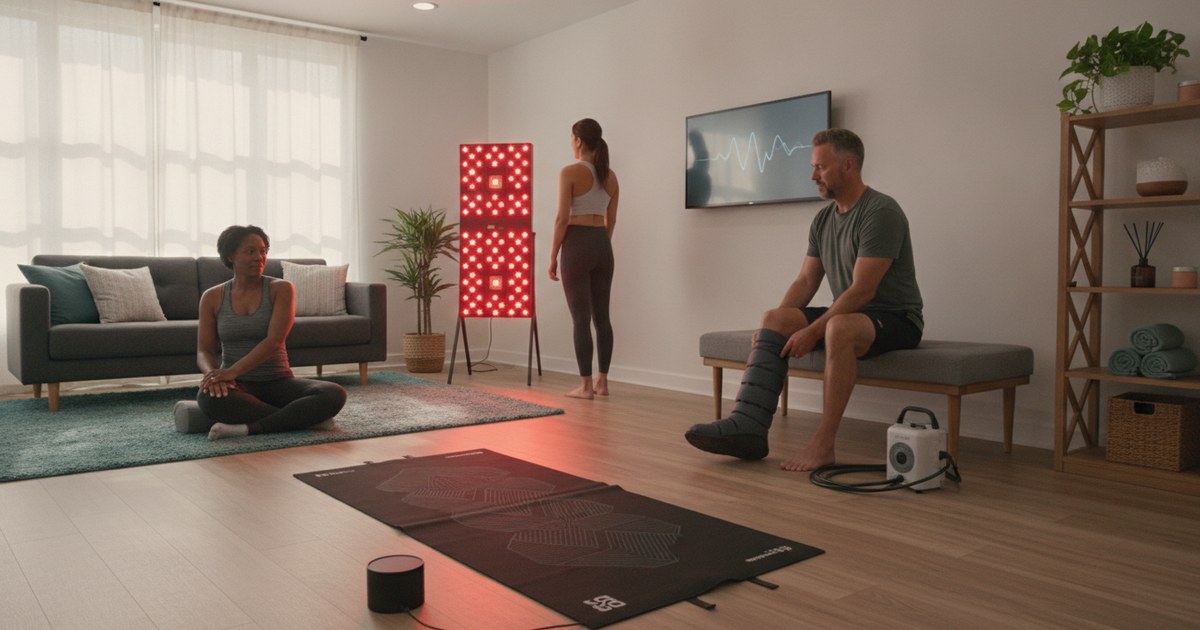
They book everything in one visit. Boots, then the mat, then the panel. They feel good walking out. Six weeks later they have spent real money and cannot tell you which part did anything, so they either keep buying all of it forever or quit the whole category out of frustration.
For one sore joint, running all three at once is the fastest way to learn nothing.
Pick the branch your joint points to. Give it a defined window, four to six weeks for most people. Keep some crude record, like how many minutes the morning stiffness lasts, or whether the stairs registered on the way up. Crude beats nothing, and it beats memory, which gets generous once you have paid for something.
Stacking has a place later, once you know your own baseline. Compression after a long day on your feet, PEMF on a different day, is a reasonable arrangement for someone who already knows what each one does for them. It is a poor place to start.
When The Menu Is Not The Right Place To Be
Some things belong with a clinician rather than a front desk.
A joint that swelled suddenly for no reason you can name. Pain that wakes you at night. A joint that is hot and red. Swelling in one leg with calf tenderness, especially after a flight or a long drive. New loss of range after a fall or a twist.
Arthritis, a meniscus tear, tendinopathy: those are diagnoses, and the useful version of this conversation starts with someone who can examine the joint and put a name on it. Plenty of people run studio recovery alongside that care. The order is what matters.
What Tends To Be True
The people who get somewhere with a nagging joint are rarely the ones who bought the most. They are the ones who can tell you, without hedging, what changed and roughly when they noticed. That answer almost always comes from having tried one thing at a time, which is slower, less interesting, and the reason they can answer at all.